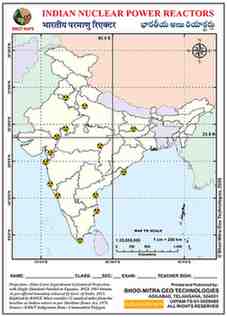
About This Map
A blank India outline map for marking every nuclear power reactor site in the country — 24 reactors generating around 8,780 MWe today at 7 operating sites, plus a further 17 reactors (about 13,100 MWe) under construction or in the pre-project pipeline toward the national target of 100 GWe by 2047. Tamil Nadu hosts the widest spread of reactor types on one map — the operating Madras and Kudankulam stations plus India's only Fast Breeder Reactor and Fast Breeder Test Reactor, both at Kalpakkam.
24 power-generating reactors across 14 sites — 22 conventional units (Nuclear Power Plant category) plus India's two Fast Breeder reactors at Kalpakkam
| State | Reactor / Station | Reactor Type | Fuel | Moderator | Coolant | Status | Capacity (MWe) |
|---|---|---|---|---|---|---|---|
| Maharashtra | Tarapur Atomic Power Station Units 1-2 (TAPS-1,2) | BWR (Boiling Water Reactor) | Enriched Uranium Oxide (UO2) | Light water | Light water | Operational (life-extension refurbishment completed 2026) | 320 |
| Maharashtra | Tarapur Atomic Power Station Units 3-4 (TAPS-3,4) | PHWR (IPHWR-540) | Natural Uranium Oxide (UO2) | Heavy water (D2O) | Heavy water (D2O) | Operational | 1080 |
| Rajasthan | Rajasthan Atomic Power Station (RAPS-2 to 6) | PHWR (CANDU-derived / IPHWR-220) | Natural Uranium Oxide (UO2) | Heavy water (D2O) | Heavy water (D2O) | Operational (RAPS-1 shut down since 2004) | 1082 |
| Rajasthan | Rajasthan Atomic Power Station Unit 7 (RAPP-7) | PHWR (IPHWR-700) | Natural Uranium Oxide (UO2) | Heavy water (D2O) | Heavy water (D2O) | Operational (grid-connected March 2025) | 700 |
| Rajasthan | Rajasthan Atomic Power Project Unit 8 (RAPP-8) | PHWR (IPHWR-700) | Natural Uranium Oxide (UO2) | Heavy water (D2O) | Heavy water (D2O) | Under Construction / Commissioning | 700 |
| Tamil Nadu | Madras Atomic Power Station (MAPS-1,2) | PHWR (IPHWR-220) | Natural Uranium Oxide (UO2) | Heavy water (D2O) | Heavy water (D2O) | Operational (Unit-1 in maintenance/refurbishment mode) | 440 |
| Uttar Pradesh | Narora Atomic Power Station (NAPS-1,2) | PHWR (IPHWR-220) | Natural Uranium Oxide (UO2) | Heavy water (D2O) | Heavy water (D2O) | Operational | 440 |
| Gujarat | Kakrapar Atomic Power Station (KAPS-1,2) | PHWR (IPHWR-220) | Natural Uranium Oxide (UO2) | Heavy water (D2O) | Heavy water (D2O) | Operational | 440 |
| Gujarat | Kakrapar Atomic Power Station (KAPS-3,4) | PHWR (IPHWR-700) | Natural Uranium Oxide (UO2) | Heavy water (D2O) | Heavy water (D2O) | Operational | 1400 |
| Karnataka | Kaiga Generating Station (KGS-1 to 4) | PHWR (IPHWR-220) | Natural Uranium Oxide (UO2) | Heavy water (D2O) | Heavy water (D2O) | Operational | 880 |
| Karnataka | Kaiga Atomic Power Project Units 5 & 6 | PHWR (IPHWR-700) | Natural Uranium Oxide (UO2) | Heavy water (D2O) | Heavy water (D2O) | Under Construction (first concrete March 2026) | 1400 |
| Tamil Nadu | Kudankulam Nuclear Power Plant (KKNPP-1,2) | PWR (VVER-1000/V-412) | Low-Enriched Uranium Oxide (UO2) | Light water | Light water | Operational | 2000 |
| Tamil Nadu | Kudankulam Nuclear Power Plant (KKNPP-3,4) | PWR (VVER-1000/V-412) | Low-Enriched Uranium Oxide (UO2) | Light water | Light water | Under Construction | 2000 |
| Tamil Nadu | Kudankulam Nuclear Power Plant (KKNPP-5,6) | PWR (VVER-1000/V-412) | Low-Enriched Uranium Oxide (UO2) | Light water | Light water | Under Construction | 2000 |
| Haryana | Gorakhpur Haryana Anu Vidyut Pariyojana (GHAVP-1,2) | PHWR (IPHWR-700) | Natural Uranium Oxide (UO2) | Heavy water (D2O) | Heavy water (D2O) | Under Construction | 1400 |
| Haryana | Gorakhpur Haryana Anu Vidyut Pariyojana (GHAVP-3,4) | PHWR (IPHWR-700) | Natural Uranium Oxide (UO2) | Heavy water (D2O) | Heavy water (D2O) | Planned / Pre-project | 1400 |
| Rajasthan | Mahi Banswara Rajasthan Atomic Power Project (MBRAPP-1 to 4) | PHWR (IPHWR-700) | Natural Uranium Oxide (UO2) | Heavy water (D2O) | Heavy water (D2O) | Under Construction (siting/excavation consent granted 2025) | 2800 |
| Madhya Pradesh | Chutka Madhya Pradesh Atomic Power Project | PHWR (IPHWR-700) | Natural Uranium Oxide (UO2) | Heavy water (D2O) | Heavy water (D2O) | Planned / Pre-project | 1400 |
| Maharashtra | Jaitapur Nuclear Power Project (JNPP) | EPR (European Pressurised Reactor) | Low-Enriched Uranium Oxide (UO2) | Light water | Light water | Planned | 9900 |
| Andhra Pradesh | Kovvada Nuclear Power Park | AP1000 (planned) | Low-Enriched Uranium Oxide (UO2) | Light water | Light water | Planned | 6000 |
| Andhra Pradesh | Kavali Nuclear Power Project | VVER (planned) | Low-Enriched Uranium Oxide (UO2) | Light water | Light water | Planned | 6000 |
| Bihar | Rajauli Nuclear Power Project (Bihar SMR site) | Small Modular Reactor (SMR, proposed) | Uranium-based (design TBD) | TBD | TBD | Proposed / revived 2026 (previously listed cancelled) | 2000 |
| Tamil Nadu | Prototype Fast Breeder Reactor (PFBR) | Sodium-cooled Fast Breeder Reactor (SFR) | MOX (PuO2-UO2) | None (fast reactor) | Liquid sodium | Commissioning (first criticality achieved April 2026) | 500 |
| Tamil Nadu | Fast Breeder Test Reactor (FBTR) | Sodium-cooled Fast Reactor | Mixed Carbide (PuC-UC) | None (fast reactor) | Liquid sodium | Operational (critical since 1985) | 13.2 |
Capacity is per station/unit-group as listed; multi-unit stations (e.g. TAPS-3,4; RAPS-2 to 6) combine several individual reactor units under one capacity figure.
Tips And Tricks
- Learn the 7 operating sites first — Tarapur, Rawatbhata, Kalpakkam/Madras, Narora, Kakrapar, Kaiga, Kudankulam — every other point on the map is a future site still under construction or on paper.
- Kalpakkam is the one site that isn't a standard power reactor at all — it houses India's Fast Breeder Reactor programme (PFBR and FBTR), which is technologically distinct from every other reactor on the map.
Comments & Issue Reporting
Sign in to leave a comment or report an issue with this map.
No comments yet — be the first to share your thoughts.