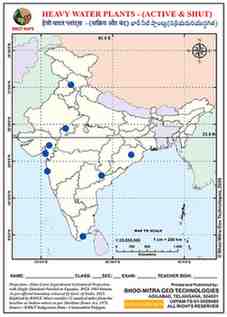
About This Map
A blank India outline map for marking all eight plants built under the Heavy Water Board programme — the facilities that produce the heavy water (D2O) used as moderator and coolant in India's fleet of pressurised heavy-water reactors (PHWRs). Four plants (Manuguru, Kota, Thal, Hazira) are currently active; the rest — Nangal, India's original 1960s pilot plant, plus Baroda, Tuticorin and Talcher — have been shut or suspended over the decades as the active plants absorbed their capacity.
All 8 Heavy Water Board plants
| Plant | State / Region-District | Status |
|---|---|---|
| Heavy Water Plant, Manuguru | Telangana — Bhadradri-Kothagudem district, on the Godavari | Operational |
| Heavy Water Plant, Kota (Rawatbhata) | Rajasthan — Chittorgarh district, co-located with RAPS | Operational |
| Heavy Water Plant, Thal | Maharashtra — Raigad district, ~100 km south of Mumbai | Operational |
| Heavy Water Plant, Hazira | Gujarat — Surat district | Operational |
| Heavy Water Plant, Talcher | Odisha — Angul district | Suspended / long-term shutdown |
| Heavy Water Plant, Tuticorin | Tamil Nadu — Thoothukudi district | Shut down (2007) |
| Heavy Water Plant, Baroda | Gujarat — Vadodara district | Shut down (2011) |
| Heavy Water Plant, Nangal (historic) | Punjab — Rupnagar district | Historic / earliest pilot plant (1962) |
Tips And Tricks
- Heavy water plants cluster near either their original fertiliser-plant feedstock or the PHWR site they supply directly — Kota and Thal are named for the reactor sites next door.
- Mark Nangal (Punjab) separately as the historical starting point — it was India's first heavy water plant — before placing the four plants that are currently active.
Comments & Issue Reporting
Sign in to leave a comment or report an issue with this map.
No comments yet — be the first to share your thoughts.